Trust The Children

Thursday, October 21, 2010

Homeschoolers using Social Media


The world is my educational Oyster!

The traditional view of education is one where students "go there" to get "it". They leave home and go to the school much like an employee going to his place of employment. Each day, at school (the learning place), education happens. Once out of school the rest of life, happens. While at school, teachers are there who have been given a curriculum, i.e. gathered material in behalf of the student, filtered it and prepared it and present it, so that students are one step removed from the actual material they need to learn. School is an interpreted environment. Rather than the student engaging with material of their interest where motivation to learn is natural, often much of the "school experience", (not all) could be defined as teachers engaging, interpreting and telling the students what the material means and what they need to know.

We might think of the teacher as a aggregator. This is a new term for many, but it means simply a person who gathers or aggregates material, synthesizes it and then shares the shorter version with others. In today's world of technology, even computers have algorithms, (forumlas) that "read" information and aggregate it, and then pass on the summary the computer produces to us. For us older folks, its kind of like "Cliffnotes", the short and to the point version of a much larger information set.

It is not uncommon for each of us to rely on and use people around us as aggregators. Whether we know it or not. We attend Sunday School, and someone is aggregating or interpreting information for us, and passing it on. We read a blog on the internet or even read the newspaper and in all of these places, information is being summarized and shared for our consumption.

Social media, like Facebook and Twitter, in a very small sense, and the world of blogs, in a much larger sense, serve the purpose of aggregation. A parent or a child, can search the internet and find blogs or topics in Facebook or even people in twitter, who have a natural interest in a topic. Once found, we can study it, and even share our views on that topic if we want, entering into a useful dialog or discussion, which we can learn from.

All of us, parents and children, can, as students, use the work of these people and their sharing on the internet for our own custom educational purposes. Over time, if we find these resources, and the people who share them, trustworthy, we can leverage their natural interests to augment and inform our own. Some people call this a Personal Learning System. I took the time to draw out this example.


This is a more adult example, but still you get the idea. It's all free and it doesn't take 6 hours a day. And it is like school, in that you are depending on others to aggregate information for you. It is like school in that you interact with others, albeit online instead of face to face. It is different than school in that you as the student learn from "teachers" or aggregators of your choice, instead of those chosen for you by the school system.

And if you like, you can create a facebook group or join one already there, and share information with others in areas of your interest. In other words, "teach one another out of the best books". You can find "discussion" places on the internet, on about any topic, by just entering these words in Google, "Blog Sailing" or "Blog Quilting" or whatever your interest is. Once you find these places bookmark them in your internet browser, or better yet, have someone help you create a topic folder named "PLS" (Personal Learning System) right in your browser, and under that topic, put the links to the stuff you want to follow and are interested in. Then in one place you have your own "School" of sorts, easy to find and use.

Your homeschool kids can do the same thing. Of course you might want to have a Parental Control Filter there and create custom permissions for the right stuff for your children, and block them from the bad stuff. (On Apple computers this is a standard feature). The world is your oyster when it comes to learning these days. It's free, it's easy, it's convenient and only requires an internet connection and your desire to read and think. You say, you don't have time ? Well, that too is your problem to solve. If you study one topic for one hour a day for a year, possibly two years, you can become the world expert on that topic according to some experts in education (Who read about education for one hour a day for a couple of years). All it takes is the vision and the will to become the educated person you want to become. And help your children do the same.

Labels: ,

Friday, January 02, 2009

Personal Learning in 2009


When I was a little boy, and the space program was in full bloom, I used to stay up all night waiting for the launch of a rocket into space. An image that always intrigued me was an astronaut surrounded by switches and gauges and knobs. He had all this control and information at his fingertips. It was all very fascinating to me then. this picture of a Boeing Cockpit will have to do, but you get the picture.

I partially fulfilled the dream of experiencing this myself when I became a pilot. While I think that world of a private pilot is still way to complicated with too many knobs and instruments, learning to combine all the information from all the instruments into my mind to help me travel safely from one place to another was fulfilling and satisfying. I guess that is why I miss it so much right now.

In a similar way, there is an idea for personal learning that I have been introduced to this last few months that has some of the same thrill and feeling of control I felt flying.

The idea is having your own personal learning environment and the giving it a bit of time each day.

Here is a link to a movie about 10 things you can do in 10 minutes that can help you in your personal learning quests. [http://www.youtube.com/watch?v=akAfCrOVhrM]

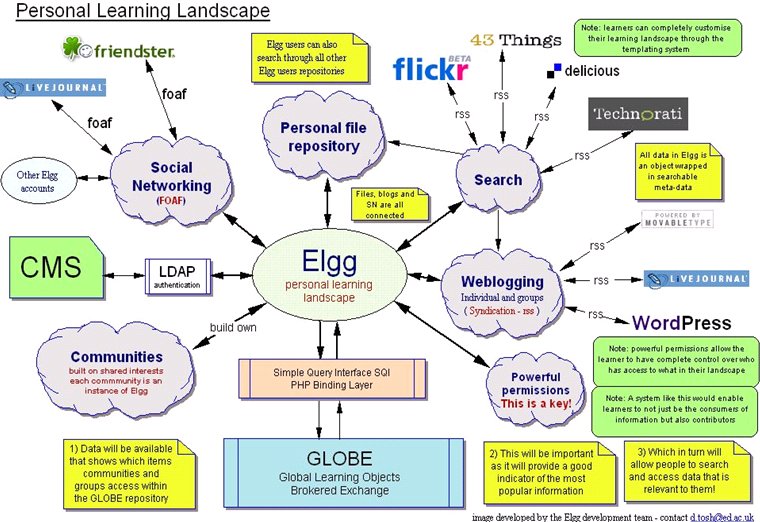
Here are some links to maps others have made that describe their own virtual personal learning environment. Before you go there, please please understand that mine isn't as complete or complicated as theirs, nor will it ever be. So think of the idea more than needing to "be like mike".

http://tesl-ej.org/ej34/m1pix/graphic1.jpg

http://octette.cs.man.ac.uk/jitt/images/5/55/Hibert_PLE_diagram_small.jpg

http://eduspaces.net/davidds/files/9773/22011/miPLEmini.PNG


I think what inspired me here, is taking the step as an adult, to promoting personal learning and growing, without needing a school, or a formal teacher or tests or evaluation or grades. I can start simple, with a blog, and facebook, and a few RSS feeds. And that can teach me a lot.

I do understand that there are many people who have given up on learning. It was like school was finally out for the last time and any form of formal learning went out the window too.

It was never that way for me. I just enjoy learning, mostly from others who are older, more experienced and smarter than I am. I was reminded recently, and painfully that for many, their circle of learning is unfortunately small and limited to like minded people and ideas. These are rarely stretched in their thinking and imagination and are comfortably "excluding" in their vision of "harmony" and group dynamics. Such people are very uncomfortable with different points of view, discussion, and the idea that others, older and wiser, could contribute to their lives in meaningful ways. Afraid I think. Did they get that fear from public schooling? I don't know, but that attitude is "I am pretty self sufficient thank you". So sad. All of us are more complete with the ideas of others.

I am in a happier place now, with others who are stretching and growing, and willing to risk sharing their ideas knowing that sometimes we are right, and sometimes we are wrong. Either way, we continue to learn in rich and deep ways. Is there exclusion here too? Sure. I think that is part of the "natural man" to hurt others through exclusion. Images of PS playgrounds, choosing teams, the new kid a school, cliques pointing and laughing come to mind. It does carry forward into adulthood. The good news is that there is less of it here, slightly. That "slightly" makes all the difference.

This idea of having a Personal Learning Environment is more available now than ever before. Instead of surrounding our selves with switches and knobs and instruments, we surround ourselves with blogs and wikis and relationships on Facebook and Ning where we can expose our ideas to others and receive their comments. Read the ideas of others and "comment" to them wanting to know more. All in all, a very inexpensive learning classroom which we make for ourselves.

Recently, I reached out for ideas from one of the social networks I belong to and had two very meaningful responses. Two people, much smarter and wiser, led me closer to finding the information I was seeking.

For me, having a PLE is important, because, of two quotes that continue to impact my life. I have blogged about them before. James Ferrell, author of "The Peacegiver" said, "Children learn more watching other people learn, than from watching other people teach." The other is from the Harvard Business School, "HOW we teach is WHAT we teach." The common thread for me is the impact of a "teacher" who demonstrates more excitement for personal learning to students, than for expounding and explaining. Having a personal learning environment, often brings to my consciousness, new ideas and perspectives about which I get very excited and animated. This personal excitement and animation is infectious. Also, my students get to see me learning about "teaching" as I try different approaches. When they observe this enthusiasm for not only the topic but the delivery of the topic, they are impacted.

So let's talk more about creating PLE's in 2009. I am preparing a presentation about PLE's and Using Technology to drive learning deeper mostly for my family, but I hope it eventually becomes good enough to post here as well.

Labels: , , ,